
Skyline Moon — News
Why the Moon has phases
The Moon does not change shape. We just see more or less of the half that is in sunlight, over a cycle of about 29.5 days.
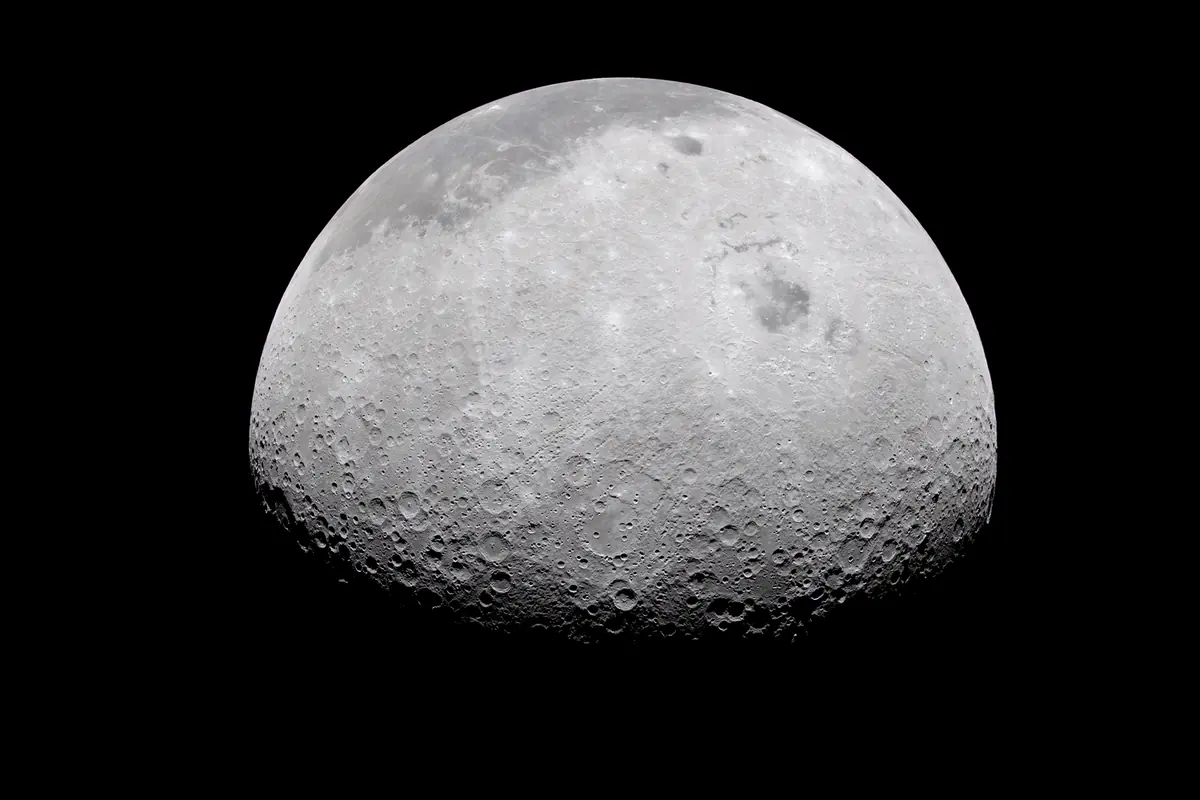
The Moon does not change shape. It does not switch on and off, and it does not have a permanently dark face. What changes is the view: how much of the Moon’s sunlit half is turned toward Earth. NASA’s Moon facts and phases pages describe the cycle that way, and it is the cleanest way to see why a crescent, a half Moon, and a full Moon are the same object under different lighting.
Once that geometry is clear, the familiar names fall into place, and so do the days when moonlight is strong or almost absent. For a related misconception, see our explainer on why the Moon’s far side isn’t actually dark.
Sunlight, not self-light
The Moon shines because it reflects sunlight. NASA notes that the Sun lights one half of the Moon at any moment, just as it lights one half of Earth. The phase we see is simply how much of that sunlit half happens to face us. At new Moon, the sunlit hemisphere is the far side, and the near side is having its night. At full Moon, the near side is fully lit and the far side is in darkness. In between, we see a growing or shrinking slice.
The Moon takes about 29.5 days to go from one new Moon to the next, a period called a lunation, or the synodic month. That is longer than the 27.3 days it takes the Moon to orbit Earth once relative to the stars, because Earth is also moving around the Sun, and the Moon must travel a little farther to line up with the Sun again.
The eight named phases
Astronomers mark four principal phases and four intermediate ones. New Moon is the moment the Moon lies in the same direction as the Sun, and the near side is dark. A waxing crescent then appears in the western evening sky, a thin sliver that grows from night to night. First quarter, despite the name, looks like a half Moon: we see half of the near side lit, and the Moon stands about 90 degrees from the Sun, high in the south around sunset in the mid-latitudes.
The waxing gibbous Moon grows fatter until full Moon, when the Sun and Moon stand opposite each other and the near side is fully illuminated. After that the sequence runs in reverse: waning gibbous, third quarter (another half Moon, now rising around midnight and high in the morning), and a waning crescent in the eastern predawn sky, back to new.
Only new Moon and full Moon are exact instants, defined by the Moon’s orbital alignment with the Sun. The quarter phases are exact instants as well, when the Sun–Earth–Moon angle is 90 degrees. The crescent and gibbous names describe the spans between those instants. A Moon can look full to the eye the night before and the night after the official full time, which is why skywatchers often circle both evenings.
Why we always see the same face
While the terminator—the line between lunar day and night—sweeps around the Moon, one hemisphere stays pointed at us. That is not because the Moon is still. It rotates on its axis in the same time it takes to orbit Earth, a match called synchronous rotation, or tidal locking. NASA’s tidal-locking explainer describes how Earth’s gravity gradually slowed the Moon’s spin until that match was reached. We only ever see the far side from spacecraft, never as a change of phase.
A small wobble called libration lets us peek around the edges over the course of a month, so in total a bit more than half the surface is visible from Earth at one time or another. The far side still gets a two-week day and a two-week night, just as the near side does.
What phases mean for looking up
Phase controls moonlight, and moonlight controls how dark the rest of the sky appears. A full Moon can wash out fainter stars and many meteors. A new Moon leaves the sky dark, which is why meteor-shower guides always mention the Moon. In November 2026 the Leonid peak on the mornings of November 17 and 18 comes just after first quarter, so the Moon sets in the late evening and the hours before dawn are dark. The Geminid peak on the night of December 13–14 comes with a waxing crescent that sets in the evening, another favorable arrangement. We collect those dates on the homepage Next section and on Programming.
Phase also tells you when to look for the Moon itself. A waxing crescent is an evening object. A full Moon rises near sunset and is up all night. A waning crescent is a morning object. Skyline’s Your Moon report on the homepage gives the phase, the illuminated fraction, and moonrise and moonset times for a chosen place, so you do not have to remember the geometry every night. The geometry is still worth knowing. It turns a change of shape into a simple fact: we are watching sunlight move across a sphere that is, slowly, going around us.
Sources
- NASA Science, Moon Phases.
- NASA Science, Moon Facts.
- NASA Science, Tidal Locking.
- NASA Science, What’s Up: November 2026 Skywatching Tips.
- NASA Science, Geminids (peak Dec. 13–14, 2026).
All times ET. Corrections: see News editorial policy.