
Skyline Moon — News
How the Moon slows Earth’s spin and steadies its tilt
Laser ranging shows the Moon receding by 3.8 centimeters a year. The same tidal friction lengthens the day and, according to landmark calculations, helps keep Earth’s axial tilt from swinging chaotically.
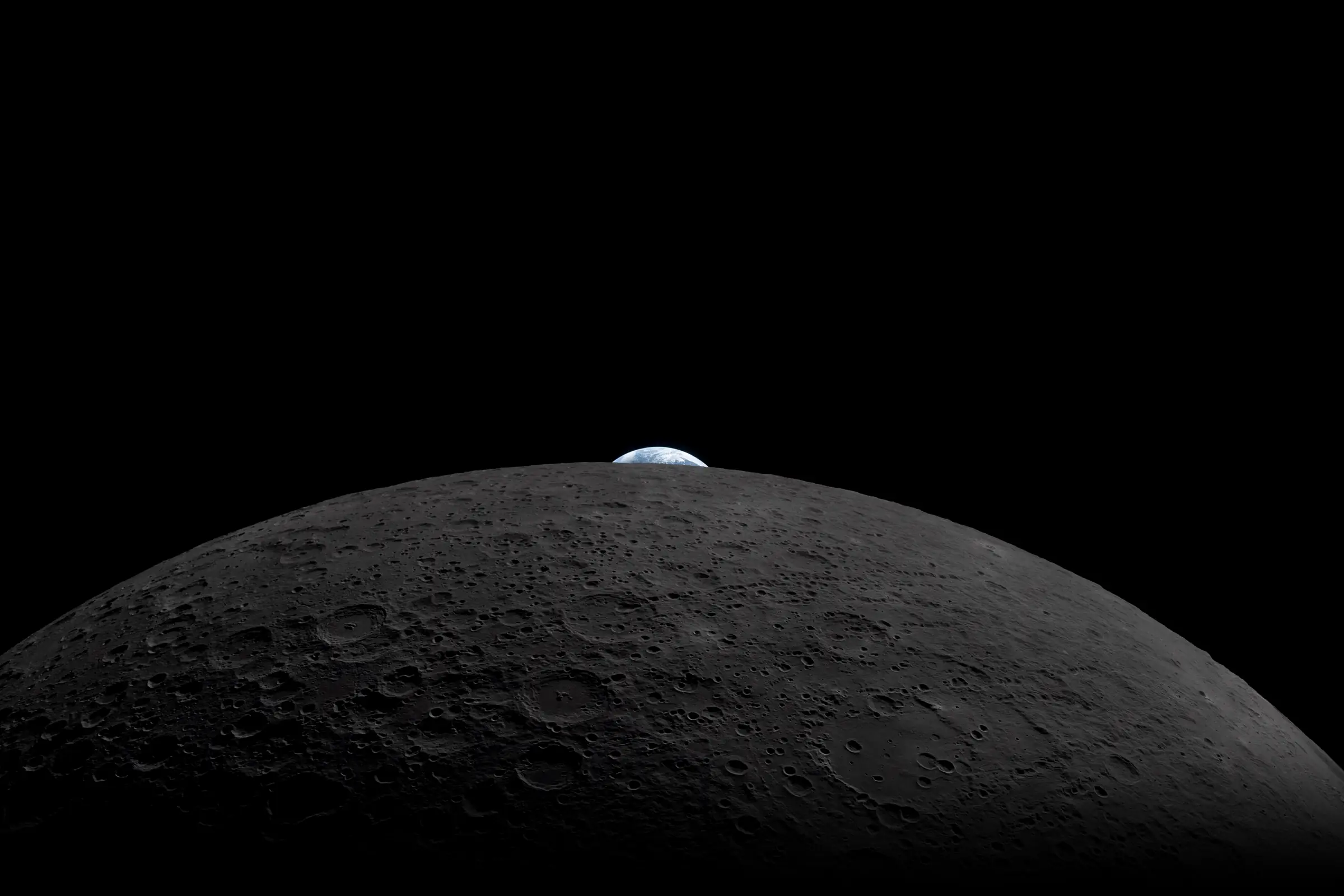
The Moon is not a still companion. It is slowly backing away, and Earth is slowly taking longer to turn. The two changes are one process, written in the tides. A third effect is quieter and just as important: the Moon helps keep Earth’s tilt from swinging wildly, which is one reason the seasons stay within a familiar range.
None of this is something you can see in a single night. It is something laser ranging, eclipse timing, and orbital models have measured with care.
A push from the tidal bulges
As the Moon raises tides, Earth’s rotation carries the ocean bulges slightly ahead of the Moon’s position. The bulges then tug forward on the Moon, and the Moon tugs backward on the bulges. NASA’s tidal-locking explainer describes the trade: friction in that interaction slows Earth’s spin, and the same interaction feeds energy into the Moon’s orbit, so the Moon moves farther out. The process is still underway.
How far, and how fast, is no longer a guess. Apollo astronauts left laser retroreflectors on the lunar surface. By timing a laser pulse from Earth to those arrays and back, researchers can track the Moon’s distance with high precision. NASA’s Goddard eclipse-timing notes state that the Moon’s average distance from Earth is increasing by 3.8 centimeters per year. Other NASA writing rounds the same drift to about an inch and a half, or about 4 centimeters, a year. 3.8 centimeters is roughly the rate at which a fingernail grows. It is small, and it adds up.
The day is getting longer
If the Moon gains orbital energy, Earth must lose spin energy. NASA’s same rotation notes put the present tidal slowing at about 2.3 milliseconds per century: each century, the average day grows longer by that tiny amount. In a hundred years, Earth falls about 40 seconds behind a perfectly steady clock. In a thousand years, the lag is more than an hour. The change is not perfectly smooth. Climate, ice, and motions in Earth’s molten core also tug on the length of day, so the exact rate wanders. The long-term tidal trend is still there, and it is why historical eclipse records, compared with modern calculations, slowly drift out of alignment unless that lag is included.
Go far enough into the past and the day was shorter. Go far enough into the future and a day will be longer still, and total solar eclipses will eventually become impossible, because the Moon will appear too small to cover the Sun. NASA discusses that distant end of the eclipse era as a direct consequence of the same recession.
A steadier tilt, for now
Earth’s axis is tilted about 23.5 degrees from the perpendicular to its orbit. That tilt, or obliquity, is why we have seasons. It is not locked in place by Earth alone. In 1993, Jacques Laskar, Frédéric Joutel, and Philippe Robutel reported in Nature that the Moon stabilizes this tilt. The Moon speeds up the way Earth’s axis precesses, keeping that motion out of step with slower gravitational tugs from the other planets. With the Moon, Earth’s obliquity stays near 23.3 degrees and varies by only about 1.3 degrees. Without it, the same models found that the tilt could wander chaotically over a huge range, potentially from nearly 0 degrees to about 85 degrees, with severe climate consequences.
The stability is not a forever guarantee. As the Moon recedes and Earth’s spin continues to slow, the precession rate will change. Later work by Laskar and colleagues found that dissipative evolution can eventually carry Earth toward a chaotic zone, on a time scale of about 1.5 to 4.5 billion years. That is a theoretical future, not a forecast for our era. For the human present, the Moon remains a reason the seasons do not swing from one extreme to another.
So the Moon’s “influence” on Earth is not a mood and not a myth. It is a torque. It lengthens the day by milliseconds in a lifetime, it opens the orbit by centimeters in a year, and it helps hold the axial tilt in a narrow band. The ocean is the messenger. Gravity is the cause. For the everyday side of that gravity, see how lunar tides work. For the way people use the word energy, see moon energy, folklore, and science.
Sources
- NASA Goddard Space Flight Center, Eclipse Predictions and Earth’s Rotation (3.8 cm/year; 2.3 milliseconds per century).
- NASA Science, Tidal Locking.
- Laskar, J., Joutel, F. & Robutel, P., “Stabilization of the Earth’s obliquity by the Moon,” Nature 361, 615–617 (1993), doi:10.1038/361615a0.
- Néron de Surgy, O. & Laskar, J., “On the long term evolution of the spin of the Earth,” Astronomy & Astrophysics 318, 975–989 (1997).
Use of NASA imagery does not imply endorsement. Corrections: see News editorial policy.